
How to Compare Fabric Quotes When Specifications Differ
Two suppliers can both quote “chenille sofa cover” and still be pricing different products.
One may be quoting a flat throw with a simple edge. The other may be quoting a multi-piece protector with anti-slip backing, retail packaging and a different delivery basis. The lower total does not become useful until the product, unit and commercial terms have been made comparable.
For an importer, furniture brand or ecommerce seller, the first task is therefore not negotiation. It is normalization.
The rule: compare only completed, aligned rows
Rewrite both supplier offers into one worksheet. Use the same units and the same requested specification. If a field is missing, leave it blank and send a clarification question. Do not fill it with an assumption taken from a photo, product name or previous order.
A price becomes comparable only when three questions have the same answer:
- What is being supplied? Product form, material, dimensions, construction, finish and packaging.
- How is it being priced? Per metre, kilogram, piece or set; at the same quantity and currency.
- What does the commercial basis include? Incoterm, transport scope, documentation, sample or tooling charges and schedule.
If one of those answers differs, the price gap may describe the missing specification rather than supplier efficiency.
Start with the finished product, not the material name
“Sofa cover” can mean a fitted cover, flat sofa throw, individual seat protector, chaise section or coordinated set. These formats use different amounts of fabric and different cutting, sewing and packaging operations.
Put the following fields at the top of the comparison sheet:
- product form and reference image;
- finished width and length for every piece;
- pieces per retail unit or set;
- fit method, overhang and orientation;
- edge construction, such as sewn hem, fringe or ultrasonic cut;
- backing, straps, anchors or other components;
- folding method and retail packaging.
For modular pads, compare the cost of the same seat configuration—not merely “one piece.” For throws, compare the same finished dimensions. A four-piece sectional set and one large rectangular throw should never share a price-comparison row.
The stock-versus-custom sourcing guide is useful here because a ready-stock size and a custom size may have different cost structures even when the fabric is similar.
A material family is not a material specification
Terms such as chenille, velvet, corduroy and faux fur identify broad families. They do not lock the fibre, construction, density, surface, backing or finished performance.
Ask both suppliers to state:
- fibre composition and blend ratio;
- woven or knitted construction;
- finished GSM and the method used to report it;
- usable width for roll goods;
- surface or pile construction;
- backing, lamination or coating;
- color reference and approval method;
- care instructions for the proposed construction.
Finished GSM matters because a pre-finish value may not describe the fabric that will be cut and packed. Usable width matters because edge loss changes yield. The article on GSM, composition and usable width explains how these fields affect material consumption.
Do not infer durability, washability or softness from GSM alone. Two fabrics with the same weight can have different yarns, structures and finishing processes. The comparison needs a specification plus a physical sample, not one number presented as a quality grade.
Convert unlike units before judging the price
A quote per kilogram cannot be compared directly with a quote per finished piece. First convert both to the same finished selling unit.
For a simple rectangular item, the starting calculation is:
Finished area (m²) = finished width (m) × finished length (m) × number of pieces
Approximate finished-fabric weight (kg) = finished area × finished GSM ÷ 1,000
This is only a starting point. A usable conversion must also account for cutting allowance, pattern direction, shrinkage allowance, edge treatment, backing, accessories, labor and packaging. If the supplier quotes roll fabric by kilogram, ask for the expected consumption and conversion cost for the finished SKU rather than estimating the complete product from fabric weight alone.
Create one comparable-cost line:
Comparable unit cost = finished goods + specified processes + accessories + packaging + allocated setup or testing + logistics included under the selected delivery basis
Use the same destination and Incoterm for both offers. An EXW figure and a delivered figure answer different questions.
Align the commercial basis
A product can be identical while the quote basis is not. Normalize these fields before requesting a discount:
| Field | What to record | Why it changes the comparison |
|---|---|---|
| Currency | Currency and quotation date | Prevents an exchange-rate or symbol assumption |
| Quantity tier | Units per SKU, color and order | Separates volume pricing from product differences |
| MOQ | MOQ by item, color, size and packaging | Shows the inventory commitment behind the unit price |
| Incoterm | Named term and location | Defines which logistics costs are included |
| Payment | Deposit, balance and payment method | Changes cash exposure and transaction cost |
| Validity | Quotation expiry and variable-cost conditions | Prevents using an expired basis for a later order |
| Schedule | Sample, approval, production and dispatch milestones | Separates production time from transit time |
Ready-stock and custom quotations also need separate labels. Zero MOQ may be available for eligible BOYA stock items, while custom production follows the approved specification and production plan. Availability, MOQ and schedule are confirmed for the requested SKU and project.
Price the claim, not just the fabric
Words such as waterproof, non-slip, pet-friendly and certified can hide different scopes. One quote may include a backing or finish while another includes only the base textile.
For each planned listing or sales claim, add four columns:
- the exact component or finished product covered;
- the process or construction being supplied;
- the evidence or test method requested;
- the approved wording and its limitations.
Printing, embroidery, jacquard, anti-slip lamination, dot coating, waterproof construction and other processes depend on the material and approved specification. Certificates and reports must also be checked for the requested SKU, market and standard. The buyer evidence map for OEKO-TEX, REACH and flammability documents shows why a supplier-level document should not automatically be treated as proof for every product.
Use this quote-normalization worksheet
| Comparison field | Required baseline | Supplier A | Supplier B | Status |
|---|---|---|---|---|
| Product form and pieces | Your approved configuration | Match / clarify | ||
| Finished dimensions | One unit system | Match / clarify | ||
| Composition and construction | Written material specification | Match / clarify | ||
| Finished GSM / usable width | Same measurement basis | Match / clarify | ||
| Backing and finish | Required processes only | Match / clarify | ||
| Packaging | Same retail or bulk pack | Match / clarify | ||
| Quantity and MOQ | Same order scenario | Match / clarify | ||
| Currency and Incoterm | Same commercial basis | Match / clarify | ||
| Evidence and testing | Same claim scope | Match / clarify | ||
| Approval and schedule | Same milestone definitions | Match / clarify |
Compare price only across rows marked “Match.” A blank cell is not automatically a supplier failure; it is a question that must be resolved before selection.
The decision rule after normalization
The lower quote should win only when the product, evidence, commercial basis and delivery plan are sufficiently aligned for the buyer’s actual channel.
If the specifications differ, identify the cost moved elsewhere. A lower product price may create a new packaging task, higher minimum inventory, missing test work or an unverified claim. A higher price may include a process that the project does not need. Normalization exposes both forms of waste.
When two aligned offers remain close, order the smallest useful sample program and evaluate the dominant risks. The sample-economics guide explains how to choose samples by decision value instead of collecting visually similar options.
A clarification message suppliers can answer
Please revise the quotation against the attached comparison sheet. Confirm the product form, finished dimensions, pieces per set, composition, construction, finished GSM, backing or finish, packaging, quantity tier, MOQ, currency, Incoterm, sample terms and production milestones. Mark any field that requires a sample or test before confirmation.
This request gives both suppliers the same baseline. It also reveals whether the open issue is price, product engineering or missing evidence.
Frequently asked questions
Can price per kilogram be converted accurately into price per piece?
Only when consumption and conversion costs are known. Finished area and GSM estimate fabric weight, but cutting allowance, usable width, pattern direction, finishing, sewing, backing and packaging must still be added.
What if both suppliers use the same material name?
Compare composition, construction, finished GSM, surface, backing and sample reference. A shared trade name does not establish equivalence.
Should freight be included in the supplier comparison?
Yes, when the buying decision is based on landed or delivered cost. Convert both offers to the same Incoterm, named location and destination assumptions before comparing them.
When is the comparison complete?
It is complete when every decision-critical field either matches the requested baseline or has an explicitly accepted difference. The approval record should state which differences are intentional.
BOYA can review a sofa-textile RFQ against a product link, reference image, size plan, market, quantity and packaging requirement. Stock, MOQ, sample terms, processes, documentation and schedule are then confirmed for the specific item and project. Send the two quote structures for a specification check.
Product family: Sofa Throw Covers
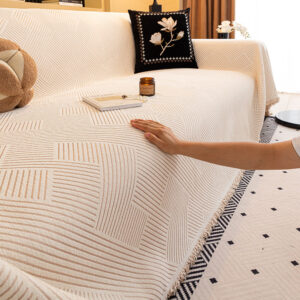
Compare by product form before checking material, size and performance. A fitted slipcover, a draped throw cover and a separate sofa pad solve different fit and merchandising problems.
Sofa Covers & Slipcovers Sofa Throw Covers Sofa Pads & Seat Covers
For wholesale or private-label sourcing, confirm the exact SKU, measurements, quantity, sample terms, MOQ, packaging and production schedule before ordering. Send BOYA your specification.
🛋️ Wholesale Sofa Covers & Home Textiles


📖 Related B2B Fabric & Sourcing Guides
- Sofa Cover Care Guide for B2B Buyers and Ecommerce TeamsA sofa cover care guide should do more than repeat “machine washable.” For a retailer,
- The $2,000 Sofa and the $500 Sofa Use the Same Fabric — The Difference Is the ColorWhy Color Is Your Most Profitable Decision Your client walks into a showroom. Two sofas
- Fabric Test Reports: Martindale, Wyzenbeek and Wash ColorfastnessA fabric report may show a large Martindale number, a smaller Wyzenbeek number and a
- Your Fabric Dye Lot Is Consistent. Your Second Order Won’t Be. Here’s Why.Here’s something most fabric buyers discover the hard way: two batches of the same fabric,
- Why One Winning Amazon Product Is Not a Growth SystemA successful Amazon listing can change a business. It creates cash flow, validates a market
- → Browse All 58+ B2B Fabric Sourcing Guides
 Scan QR Code